
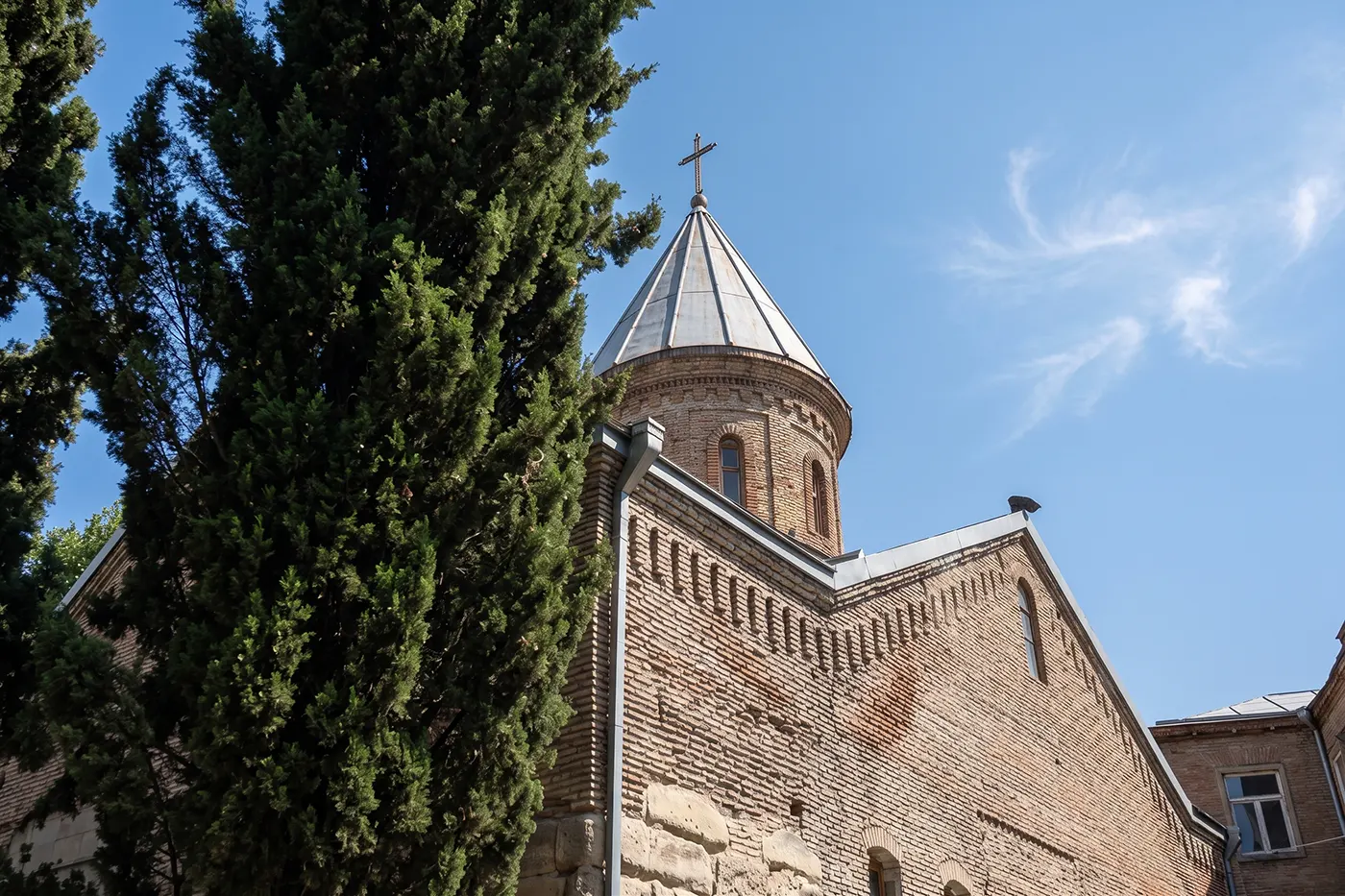
The Lurji (‘Blue’) Monastery
A 12th-century cruciform church
Back then, in order to reach the Lurji Monastery, you had to walk along the Mtkvari river, passing the Nikitin Brothers’ circus with the acrobat Jakolino. Then you would cross the old bazaar of Vera, walk up the new Korghanov Street and pass the Bellevue Garden, until it burnt down with all its fagottos and contra-fagottos, houses that were heated with mazut (heavy fuel oil), and people would complain that the soot from the stovepipes sticking out of the windows was blackening the walls of the houses. Then you would reach the Russian church and the Lurji Monastery right next to it, named after the blue tiles covering its roof.

The Gabashvilis claimed it as their family church, just as they also claimed almost all of Vera—‘All this land is ours,’ from the hill of weavers, passing the dukhan (tavern) of ‘Tanz-Georga’, Akhali Golandiya (‘New Holland’) and Khlebnaya Gorka (‘Bread Hill’). And in Zemo (‘Upper’) Vera especially, from the Vardisubani (‘Roses’) area all the way to the Ojio neighbourhood—they believed that all this was theirs.
The Azerbaijanis of the Ojio area are still to be found in Vera’s cemetery, and Suleimana Lakhlukhi, who looks after the graves, would steal the donkey that Konstantine Gamsakhurdia had left to graze and would gallop around on it. His grandfather, ‘Sultan Suleiman’, had four wives and a big jet ring on his finger. But we have wandered off and left the Lurji Monastery behind.
It was built as early as the 7th century and has been changed many times: at some point it was roofed in a basilica style, before later being used to store gunpowder and turned into a museum of medicine, and it has reached us in the shape of a domed cross-in-square church.

Zakaria Gabashvili, the father of Besiki, who was the driving force of politics and of the entire court, served at this monastery. Vakhushti was referring to him when he said that ‘there was only one priest in that monastery’. Zakaria was a wrathful man, and was complaining to the Russian synod that Catholicos Anton was translating Latin books. The governor of Tiflis at the time was David Sardali, who besides being the hero of the Battle of Aspindza also translated the Karamaniani from Persian.
Among the city’s other governors, Dimitri Kipiani comes to mind, who was a writer and even translated Romeo and Juliet. And it was Zakaria’s son, Besiki, who got involved in a love story similar to the Montague-Capulet one, falling in love with the widow of a nephew of King Erekle II, and who as proof of his love thundered:
O graceful stature,
You heart-snatcher,
With your distinctive motion!
The curling locks of your hair…
Love should be like that.
Text: Abo Yashaghashvili | Photo: Nina Kunchulia | Translation: Alexander Bainbridge