
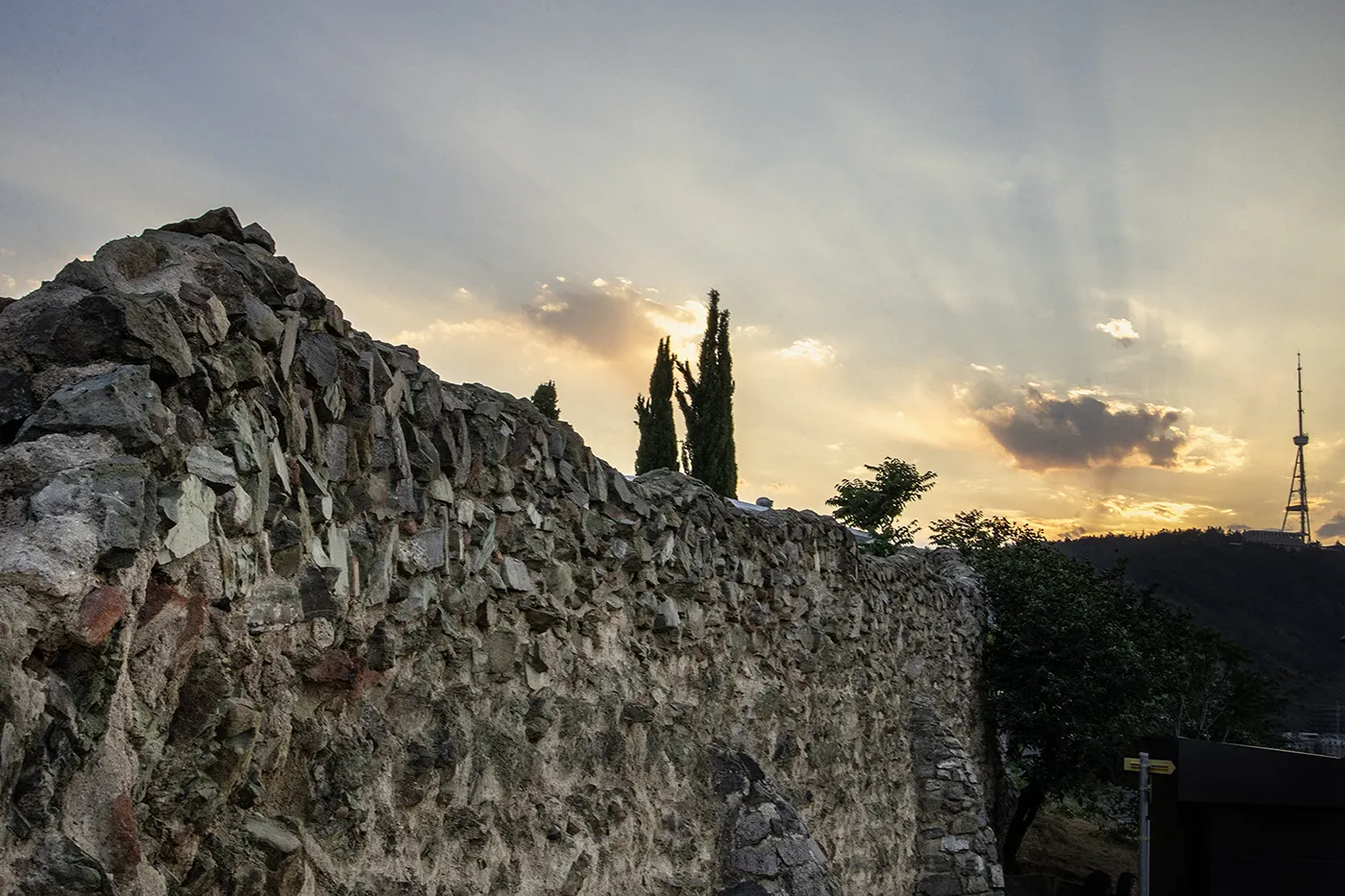
Narikala
A fortress of the IV-VIIth centuries A.D.
Narikala derives its name from Narin Kala, i.e. ‘small castle’ or citadel, and was destroyed and rebuilt countless times. Architecturally, the current site preserves buildings and structures that date back to the Middle Ages, but the castle originally dates all the way back to the Vth century, when its garrison was Persian.

When the Persians tired of their guard duties, they would hang their swords on a nail and, as was their habit, some would sell pomegranates, others figs, and yet others birds caught by the waterfalls in the neighbouring gorge. Some birds even fought with each other, and people would engage in the old Persian game of quail fights and would place bets on them.
Pedar sookhteh! May its father burn! the Persian guard who had just lost would curse fiercely.
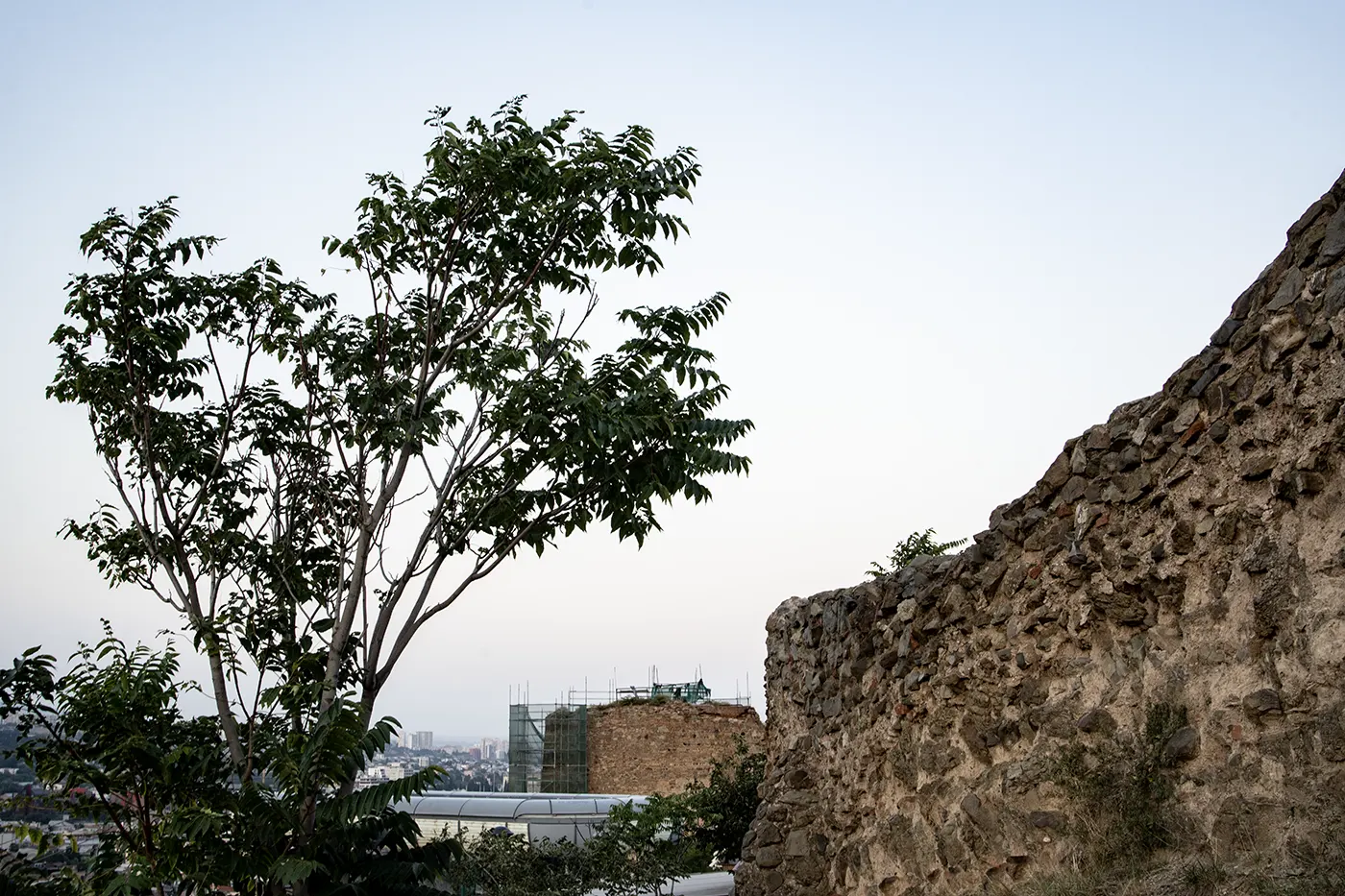
Only by observing the walls of Narikala and the strata of its towers can one understand the different origins of the garrisons who manned it and who ruled Tiflis at the time. The Tabriz Tower, with its diamond-shaped bricks, is a demonstration of the growing power of the Shiites over Tiflis, whereas the Istanbul Tower tells the story of the arrival and establishment of the Ottomans in the city.
The Istanbul Tower even contained a dungeon. This became the city’s one and only prison, into which everyone was thrown without distinction, be he a thief or a gambler, a murderer who had slaughtered a merchant on the highway or a forger. ‘Kleketsa’, the very first forger in Tiflis, who is mentioned by Grishashvili, must have been imprisoned down there, too. Back then, it was the Arabs and the Emir Sahak who governed the city. When he tired of watching the peacocks in the Emirs’ Gardens, he would climb one of Narikala’s towers and look down upon the river that was named after the Persian king Cyrus, who drowned in it; or sometimes pass by the observatory that had been built atop one of Narikala’s heights, whose existence was even known to Hārūn al-Rashīd in the Arab capital Baghdad.
Tell me, can you see the fifth clime of the sky? Sahak would ask his hunchback astrologer. ‘Nor even the one that the Prophet Muhammad reached with his mare Al Buraq?… No?… Then what kind of a prophet of the stars are you?’ Perhaps he would also have had his astrologer thrown into Narikala’s dungeon, where the hunchback would have taught Kleketsa all about how he and his ancient forebears in Baghdad saw the sky and the heavenly bodies. Although this is a completely different story—a friendship between an outcast and a connoisseur of the ‘climes of the sky’—it did indeed happen to others in the dungeons of the Château d’If, whereas with us, it has been kept in completely different kvevris.
Text: Abo Yashaghashvili | Photo: Nina Kunchulia | Translation: Alexander Bainbridge